
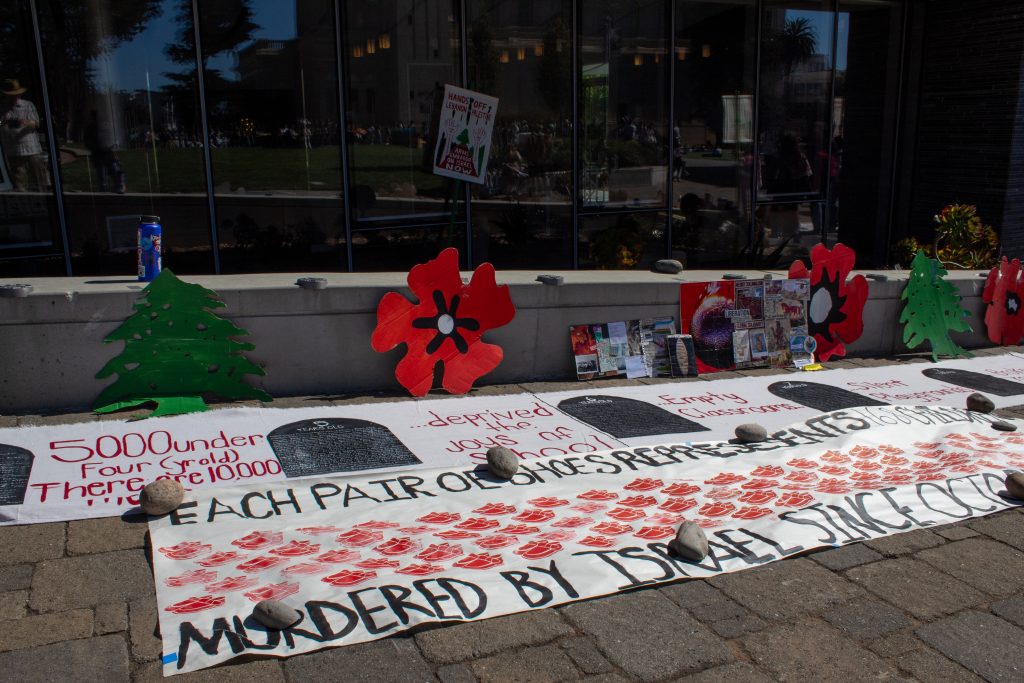
USFCA Students For Palestine hosted a “silent museum” on Oct. 8 as part of a “Week of Rage” held from Oct. 7 to Oct. 11.
The group hosted events each day, including the museum, fundraising, a screening of the documentary “Israelism,” a student-led teach-in and the distribution of political education resources, according to the @USFCAStudents4Palestine Instagram account.
Oct. 7 marked the one year anniversary of Hamas’s attack on Israel, which ignited the ongoing genocide in Palestine. Al Jazeera reported, “Gaza’s Ministry of Health says more than 42,500 Palestinians have been killed in Israeli attacks and thousands [have been] buried under rubble and threatened by illness” since Oct. 7, 2023.
The silent museum, which took place on Oct. 8, was the most visible of the demonstrations according to Ani De Lira Lopez, a junior history major involved with USFCA Students for Palestine. Outside of Lo Schiavo, students stood holding signs, accompanied by various works of art. The event took place across from a “First Fifty Days” celebration in Gleeson Plaza.
One museum display included painted cardboard cutout cedar trees, which are on the Lebanese flag, and poppy flowers which are symbolic of Palestine. They were donated by Arab Resource and Organizing Center, who had used them in a previous demonstration. “We strung [the poppies and cedar trees] next to each other in showing the solidarity between the struggles. I think that was really powerful,” De Lira Lopez said.
On Sept. 30, the New York Times reported that Israel began a ground invasion of southern Lebanon. According to the BBC, Lebanon has endured weeks of aerial bombardment since the invasion began. The Lebanese health ministry estimates that 2,300 have died and 1.2 million have been displaced as a result.
The silent museum also included a long scroll, with illustrations of 18 gravestones, labeled ages zero to 17. Below each number, the tombstones had the names of dozens of Palestinians who have been killed in the conflict. “I think people really took that one to heart, because you could walk across it and see just how many child martyrs have been killed,” said De Lira Lopez. On Sept. 17, Save the Children, a humanitarian organization dedicated to protecting children, reported that more than 1,500 children have been killed or injured in Palestine since Oct. 7, 2023.
Additional works at the museum included two jars filled with rice. Each grain represented “$1.5 million in U.S. taxes used to fund Israeli Apartheid since 1946” according to a placard. There was also a bottle of brown water on display representing “what Palestinians are able to access in terms of drinking water.” De Lira Lopez said, “It’s very cloudy and dirty.”
According to the nonprofit American Near East Refugee Aid (Anera), “Throughout Gaza, most tap water is unfit for human consumption. Some 97% of water from Gaza’s aquifer does not meet the quality standards of the World Health Organization.”
Lucia Baughman, a freshman dance major, attended the silent museum. “[The banner] is really, really impressive. It’s really the type of thing that’s going to make people come and look and understand what’s going on,” she said. “Each age signifying something different that these people won’t be able to experience is really powerful.”
The Foghorn will continue to report on student demonstrations throughout the semester.
Editor-in-Chief: Jordan Premmer, Chief Copy Editor: Sophia McCrackin, Managing Editor: Jordan DelFiugo, News Editor: Phebe Bridges, Sports Editor: John Lindroos
