
Will random aesthetics replace youth subcultures?
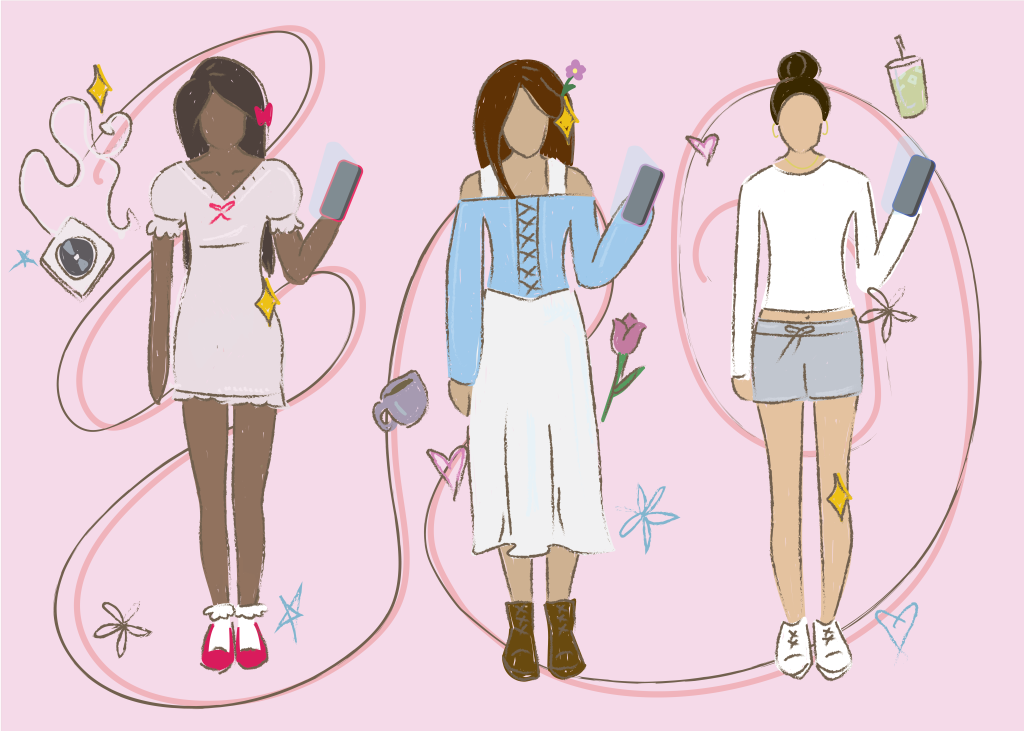
You open your Tik Tok to see the words “clean girl,” “coquette,” and “cottage core.” But what does any of that mean?
Welcome to the world of aesthetic culture, a phenomenon that has taken over today’s youth. You will find words and phrases that sound more like a costume or a character, rather than an actual lifestyle. This vocabulary is born out of boredom and a lack of outlets for young adults.
While the word aesthetic means to be “concerned with the beauty or the appreciation of beauty,” there is a completely different meaning when it comes to Generation Z. In our case, it is meant to be a subculture, but in reality it is just our way of finding a sense of belonging.
Youth subcultures have always existed, but the internet has made these distinctions primarily about visual appearance and social media presence. This shift started in 2019 with the term “VSCO girl,” an aesthetic that according to dictionary.com, “posts trendy pictures of herself edited on the app VSCO” and wears “scrunchies and Birkenstock sandals [and drinks] out of Hydro Flask reusable water canisters, saying “sksksk” and ‘I oop…’” This quickly became the blueprint for other aesthetics.
When the COVID-19 pandemic began in 2020, more aesthetics popped up because young people were stuck inside on their devices. A popular aesthetic was “indie girl,” which is someone who would over-saturate their photos, have colored hair, wear bright colors and have cow print everywhere. A septum piercing is another defining accessory for the 2020 “indie girl.”
Today, in 2024, although youth can be outside and connect with individuals who are similar to them, aesthetic culture still takes over the internet. Current popular aesthetics include “coastal grandmother,” where one wears Ralph Lauren and linen; “vanilla girl,” where one wears white or cream clothing and smells like vanilla; and “downtown girl,” an aesthetic that emphasizes city style, including motorcycle boots and slouchy, vintage purses.
The current fascination with aesthetic culture stems from a deep rooted struggle with identity and a desire for belonging, along with social media playing a huge part in our lives. Based on a study by Forbes, 97% of Gen Z use social media as shopping inspiration. Adopting specific aesthetics offers a sense of community and validation, particularly in a world where social media plays an influential role.
Constant exposure to curated trends and the pressure to stay on top of the latest fads often leads individuals to conform in order to find a sense of belonging. As a result, many Gen Z may find themselves losing touch with their personal individuality, becoming increasingly absorbed in surface level aesthetics. While embracing a style that genuinely resonates with one’s identity can be enriching, the casual and sometimes careless use of aesthetic labels has diluted their meaning.
At USF, aesthetic culture heavily influences students even though there are different clubs and organizations that adhere to their interests. Elijah McLeod, junior finance major, agreed, saying, “I think people make up aesthetics [because] it gives you a sense of identity that’s specific to you and a small group of other people. I think it also makes people feel unique to be able to name their style.”
Paola Guerra, junior international studies major, explained how social media platforms amplify this need for a label, noting, “It’s almost like if you don’t fit into an aesthetic, you’re invisible online. People want to be noticed, and the easiest way to do that is to attach yourself to something trending. But at the same time, it’s hard to keep up because what’s popular is always changing.”
Guerra also discussed the impact of aesthetics on her own experiences at USF. “Even on campus, you see certain aesthetics in different groups. The pressure to adhere to a look or vibe can sometimes overshadow the real connections we could be building. It’s like, if you don’t present yourself in a certain way, you might feel like you don’t belong, even in a community of like-minded people.”
In a world where identity is constantly shifting, it’s easy to see why aesthetics have become a form of expression for many teens and young adults. At the surface, these labels may offer a sense of uniqueness or community, but they often fall short of genuine self-discovery. While aesthetic culture dominates social media and fashion trends, it is clear that this search for belonging is deeply intertwined with a desire for validation and connection in an increasingly digital world. Individuals are constantly molding themselves to fit what they see online, when they should adhere to what they feel and see in person.
Despite its popularity, aesthetic culture risks reducing individuality to a set of prescribed traits and appearances. Naming your style can make you feel unique—but true uniqueness does not come from fitting into a predefined box. It’s time to rethink how we define ourselves, beyond fleeting trends and surface-level aesthetics. After all, the most authentic form of self-expression comes from within, not from a hashtag.
Editor-in-Chief: Jordan Premmer, Chief Copy Editor: Sophia McCrackin, Managing Editor: Jordan DelFiugo, Opinion Editor: Dakota Duran, Scene Editor: Elina Graham
