
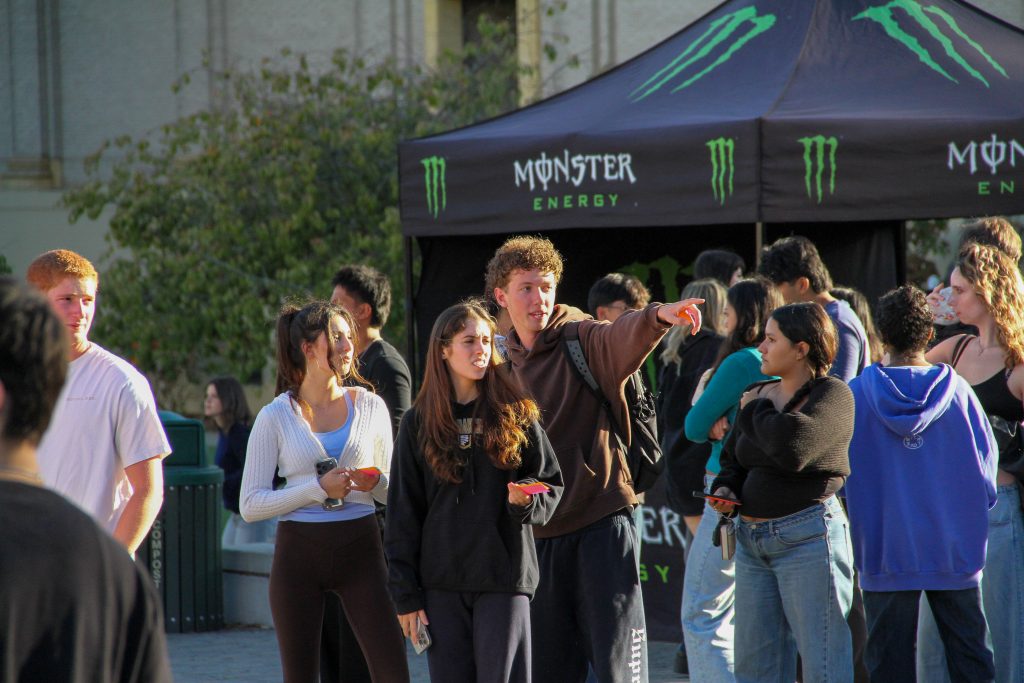
This fall, USF exceeded undergraduate enrollment goals with an incoming class of 1,873 first-years and transfers. In the past, fall classes of 2023, 2024 and 2025 all fell below the target of 1,750 students per class according to a now removed speech from President Salvador D. Aceves at this year’s convocation on Aug. 20.
In the same speech, Aceves described enrollment as the focus for the upcoming academic year, but why is this increased class size significant? Eric Groves, vice president for Strategic Enrollment Management, described in an online interview, “Last January, the university began the process of developing a Strategic Enrollment Plan, which is a campus-wide endeavor to define enrollment and shape the future of USF.” This Strategic Enrollment Plan aims to establish sustainable enrollment and net tuition revenue, with a return to larger class sizes as Grove cites, “Remember that the class that just graduated last spring was roughly the same size as this incoming class. 1,800 or 2,000 first-year students might change things, but this year’s class is just back to normal after three lower enrolled classes.”
Nevertheless, a number of continuing students have commented on their difficulties finding housing on campus.
In past years, the lower enrolled classes allowed many continuing students to obtain on-campus housing, this cushioned many students from the increasingly competitive San Francisco housing market with the AI tech-boom. However, with the increased class size came noticeable changes in student housing to accommodate additional students.
Torry Brouillard-Bruce, senior director of Student Housing, responded to an inquiry regarding changes in housing, “The biggest adjustment made to support this larger-than-expected first-year class was to utilize floor lounges in Hayes-Healy and Gillson. This allowed us to ensure we could accommodate all first-year students who applied for housing. We also made some adjustments to how we use rooms in Toler. With the larger class size, we adjusted rooms from continuing student occupancy to first year student occupancy … For Fall 2026, the university moved to a first-year live-on requirement. This was instituted as part of the housing application process. Students did have a process to request an exemption from that policy and each request was reviewed by Student Housing.”
Required first-year student occupancy has changed the landscape of student housing on campus. Savvy Giang, a fourth-year marketing major shares his experience: “I had to give up my last apartment because I was studying abroad; my roommate and I were both studying abroad … But because of that we were left without a place to live and had to join the rat-race again. That entire process for me and my roommate has been grueling this entire summer. We’ve been to so many open houses, applying to so many places.” For continuing students, these frustrations are echoed by a perpetual waitlist.
Despite the accommodations made, there are still approximately 300 continuing and graduate students on the waitlist, though as of writing, around 50 students on the waitlist are actively responding to communications from Student Housing. Georgia Engle, a fourth-year politics major, recounts, “Student Housing told me that this semester had an unprecedented waitlist for students in need of housing; almost 200 students on the waitlist at the beginning of summer. Basically they implied at the beginning of the summer I would have housing because of this pattern where over the summer they usually empty out — which is not the case now. If they overenrolled by 150, then that would explain the long waitlist, and this false assumption left a lot of students like myself struggling to find affordable off campus housing and anxiously waiting to get off of the on-campus waitlist”
Of the students on the waitlist, Brouillard-Bruce describes the likelihood of housing for these students as “not unlikely, but it’s not likely, most of our movement happens before the census date.”
Housing tensions are felt on campus as those who have found housing recount the experiences of friends who have yet to find housing. Hamza Faisal Sami, a third-year economics major and resident advisor in Toler, details, “What is kinda crazy is that the juniors and seniors who are looking for housing, a lot of them never found it. When I asked them where they were living, they’d say, ‘Oh, I’m living in a hotel,’ or, ‘I’m living in Oakland with my uncle.’”
Some continuing students are confronted with growing unease as difficulties in the changing San Francisco housing market are compounded by limited housing options on campus as student housing regulations are changed in pursuit of a transformed university enrollment plan.
