
Georgia Engle

The Core Redesign Task Force held two student feedback sessions last week on April 8 and April 9. Currently, students must take 128 credits to graduate, with the new proposed curriculum, students will be required to take 120 credits, with eight credits being cut from the core curriculum. According to the committee, student feedback will help determine the new model of the changed cores.
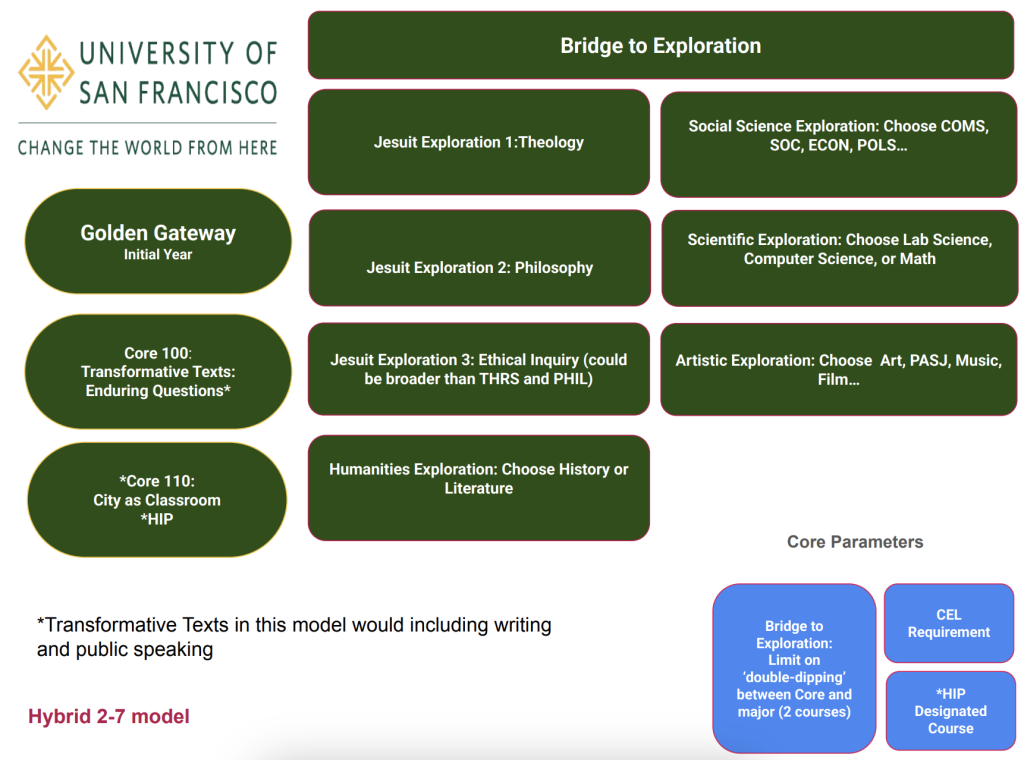
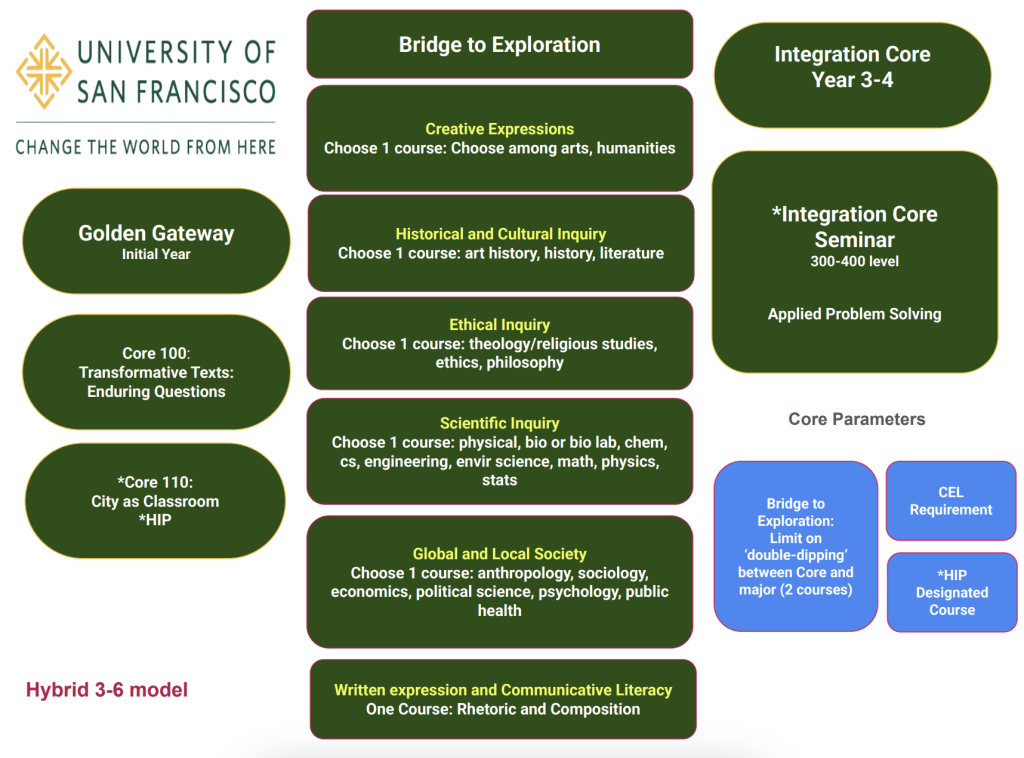
The proposed models, as previously reported by the Foghorn in our April 3 issue, include hybrid integrative and distribution models.
Distributive models are general education requirements that provide students with schooling in various disciplines regardless of their major. Integrative models are generally interdisciplinary, but are organized by theme, competency or skill. The first model is a Hybrid 2-7 model, which includes two integrative cores and seven distributive cores. The second model, a Hybrid 3-6 model, has three integrative and six distributive cores. Each course in the models is assumed to be worth four credits, with the redesign taking into account the Provost’s request to design a 36-credit core.
The task force used data from the Undergraduate Core Curriculum Redesign Student Survey Report media released on March 4, 2024 to evaluate the current state of the core curriculum. Deeya Gupta, the Foghorn’s news editor and a senior media studies major attended the April 9 meeting. “I had the chance to read the 42 pages of the student redesign survey,” said Gupta to McBride. “You ask a lot of important questions such as ‘How did the core help you?’ ‘How did it expand your knowledge?’ […] And that’s all great knowledge, but the one question the survey doesn’t ask is what core students find most important. I think sending out another survey that asks direct questions like this would be helpful.”
McBride emphasized that the survey focused on the core’s learning outcomes rather than the core disciplines, and did not want the survey to become an opportunity for students to express grievances about their professors or classes. McBride did not say whether the task force would consider another survey.
“I really hope we preserve the broad, liberal arts nature of the core,” said Mark Miller, associate professor of theology and a faculty representative on the Core Redesign Task Force. “A broad core is so important for our students because only about 20% of college graduates end up in a career that they majored in, and Americans change careers an average of 4-5 times in their/our lives,” wrote Miller in a statement to the Foghorn.
One of the goals of the redesign is to allow students to add more majors or minors to their schedule. The task force aims to make the cores more “transfer student friendly” by removing cores and including the integrative models. The model will be chosen and finalized by the end of this year.
Camryn Hissen, a senior biology major, said she prefers the 2-7 model because it has more distributive courses. “I’ve always been curious about all areas of study so I like that distributive courses are dedicated to one subject, we get to go in depth,” said Hissen.
Madison Avery, senior education major, said, “I like the [3-6] model that includes the applied problem solving capstone.” Keally McBride, the chair of the politics department and member of the redesign task force, described the capstone, officially known as the Integration Core Seminar, as a resume booster that provides students with experience in their field before they graduate. In this model, the Integration Core Seminar would be an addition to the current capstone.
“I think a core requirement that is lacking is a social and racial justice class that centers Black and Indigenous history and addresses white hegemony in education and other structures in our society.” Avery continued, “USF touts itself as a social justice oriented school, so if it wants to claim that title, social justice should be centered as much as everything else in the core.”
Daniel Morgan, a junior theology and religious studies major, said he is “concerned that important subjects such as theology and philosophy might be overlooked in the new core (especially the 3-6 model) — reduced to mere menu options.”
Morgan continued, “I think these fields are vital for understanding society, the universe, and our place in it. The fact that we are a Jesuit university lends even more importance to these subjects being taught as part of the core. I transferred from SF State largely because of USF’s Catholic, Jesuit identity—an identity I very much want this school to preserve.”
In defining a Jesuit education, McBride quoted former USF president, Stephen Privett, who said, “One out of 100 people on the planet get a college education, and we want USF graduates to turn around and think about the other 99 who didn’t get that education.”
Miller said, “The exposure to many disciplines in a core gives college grads the flexibility to switch careers if/when their own preferences change or the economy does. And a broad education helps us become better, more ‘whole’ people.”
Editor-in-Chief: Jordan Premmer; Managing Editor: Jordan DelFuigo; Chief of Copy: Sophia McCrackin; News Editor: Deeya Gupta; Sports Editor: John Lindroos
